


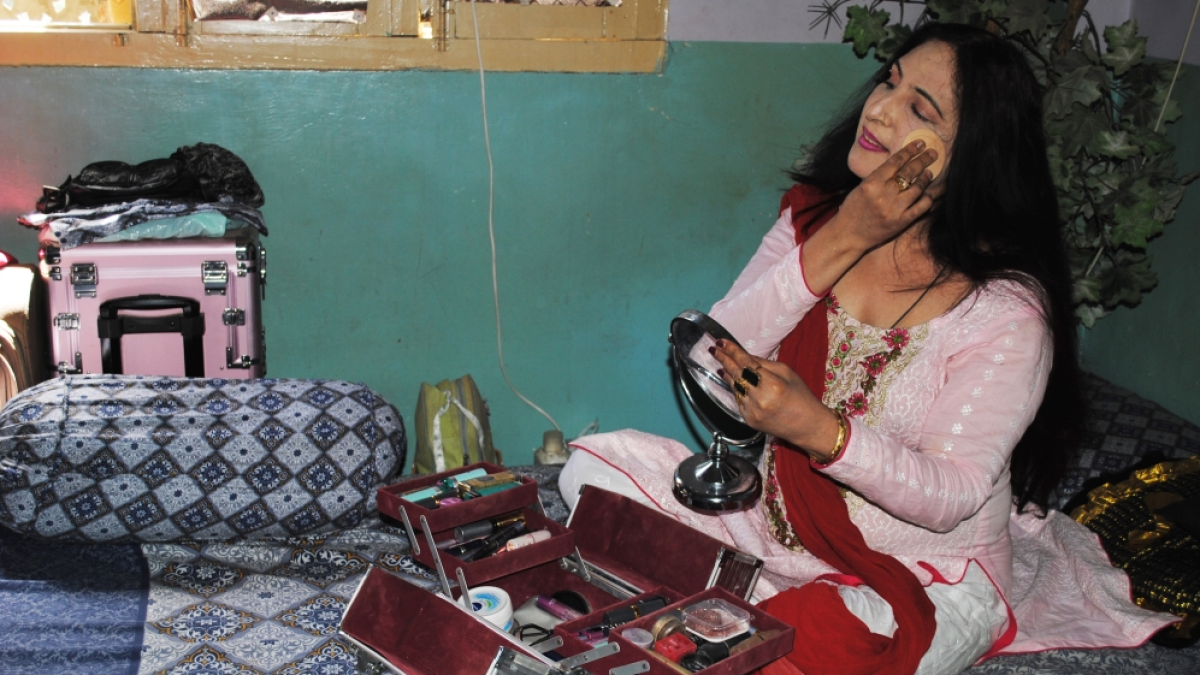
PIC SOURCE ALJAZERA
In Khyber Pakhtunkhwa, where life is governed by strict cultural and social norms, gender identity remains a sensitive subject—one that many do not speak of openly, and even fewer acknowledge without judgment.
Transgender persons who defy the traditional gender norms often find themselves at odds with social expectations. They encounter stigma that begins at home and follows them into the streets, schools, workplaces, hospitals, and public institutions resulting into multiple layers of discrimination, and widespread social exclusion. Their very identity becomes a source of vulnerabilities. Rejection and forced eviction by families, harassment, physical violence, denial of basic services, very limited access to education, employment and livelihood opportunities and an absence of safe shelter, creates a cycle of marginalisation that seems impossible to escape. “In my journey as a transgender rights activist since 2010, I have witnessed 5,000 cases of violence against members of my community. Not even one has received justice.” – Farzana Riaz, leader and president of TransAction Alliance Khyber Pakhtunkhwa (Provincial Alliance for Transgender Persons)
2018 brought a ray of hope in the lives of transgender community as Pakistan enacted the Transgender Persons (Protection of Rights) Act 2018, which was hailed as one of the most progressive laws in South Asia. It granted transgender and gender-diverse persons the right to legal recognition based on their self-perceived identity. For a community long pushed to the margins, this law symbolized dignity, protection, and hope. It marked the beginning of what many believed would be meaningful inclusion of transgender persons in public life and mainstream society. But this hope was short-lived.
Four years later, in 2023, the Federal Shariat Court declared several key provisions of the Act including 2(1)(f), 2(1)(n)(iii) providing definitions of gender identity and transgender person, section 3 providing a right to “self-perceived gender identity” and registration with NADRA and other government departments based on it and section 7 providing right to inherit property based on the self-identified gender, as repugnant and against the injunctions of Islam. However, an appeal against the Federal Shariat Court judgment was filed in the Supreme Court and as per Pakistan’s constitutional framework, the decision of the Federal Shariat Court shall not take effect until the appeal is disposed of. Since the appeal is still pending, the law remains intact but the confusion spread quickly and still exists. Public institutions, lacking understanding, awareness and sensitivity, act with uncertainty, and with bias towards transgender community.
Despite the fact that NADRA is issuing identity cards to transgender persons with gender marker “X”, only 173 transgender persons have obtained their X cards, while the population of the community in the province exceeds 70,000.
Mahi Gul, a transgender rights activist from Peshawar, reflects on why:
“The moment transgender persons disclose their identity and express their intent to transition from their gender; their families abandon or threaten them with honor killing because for them it is bringing dishonor to the family. This fear stops many from getting legal recognition under the X-card”.
“But those who have it, are still waiting for the entitlements and opportunities it was meant to provide; it has become nothing more than a showpiece on the shelf,” she added.
The provincial government announced 0.5% employment quota for transgender persons in 2024 which ensures that for every 200 appointments, one position would be designated for transgender candidates. However, it has remained only on paper. Not a single transgender person has been appointed under this quota to date and institutions continue to view them as invisible.
Beyond legal battles and bureaucratic hurdles lies a darker reality—personal security. Transgender persons are mocked, ridiculed, threatened and are attacked and murdered in streets and public places. According to the TransAction Alliance, more than 190 transgender persons have been killed in Khyber Pakhtunkhwa since 2015. Most of the cases remain unreported mainly due to lack of support, stigma and inadequate justice delivery mechanisms leaving them without protection.
“Every derogatory comment chips away at your dignity. Every act of violence reminds you that your life is considered less valuable. This daily struggle for belonging makes us question our self-worth and leads to growing mental health crisis including anxiety, depression, and even suicidal thoughts among the community members” – says Sobia, a young transgender rights activist.
The drafting of the Khyber Pakhtunkhwa Protection and Welfare Policy for Transgender Persons 2025 by the Social Welfare Department was a meaningful policy reform marking a major milestone and step toward social justice. It outlines measures in connection to legal documentation, and registration, security, government schemes, social welfare programs, health, education, law enforcement, employment and local governance among the others. The policy aimed to ensure non-discrimination, equal access of transgender persons to public and private services, and their meaningful participation in social, economic, and political spheres. But it remains stalled due to objections raised by the Law Department, deeming it against the principles of the state and Islam. With the passing time, the policy gathers dust while violence gathers victims.
Discriminatory attitudes and inhuman treatment towards transgender persons do not end in public places, they are also reflected in the service delivery systems which are meant to facilitate all the citizens equally. Although the Government of Khyber Pakhtunkhwa has recently developed comprehensive Guidelines for Departmental Engagement with Transgender Persons, outlining department-specific roles, responsibilities, and Standard Operating Procedures (SOPs) to enable the practical inclusion, facilitation, and representation of the transgender community in government institutions and public life, the mechanisms for their adoption and implementation at institutional levels remain inadequate.
Over the last two months, police across districts of Swabi, Nowshera, Charsadda, DI Khan, Bannu, Buner, and Malakand have forcibly evicted transgender persons from their homes. Fueled by hate campaign, the police officers have been holding meetings with local elders and clerics of the districts, encouraging them to drive transgender persons out of their communities, labeling their means of livelihood; performing at weddings or celebrations as immoral. “In places like Swabi, transgender women were given 15 days to leave their homes and were physically assaulted before being expelled”, quotes Farzana.
Healthcare, too, remains inaccessible. Many transgender persons are denied treatment, mocked, misgendered, or simply refused admission when they go to the healthcare facilities in relation to their healthcare concerns. Although hospitals claim to have allocated separate wards, in reality, transgender patients are pushed into a never-ending debate of male or female, all while their dignity hangs in the balance. Some have lost their lives waiting. The tragic death of Alisha amidst the hospital staff argument over whether to place her in a male or female ward reflects the bias and institutional prejudice against transgender persons.
Democracy is built on the principle of representation but for transgender persons, political participation remains a distant dream. Many face ridicule at polling stations, harassment by the polling staff, or outright refusal to facilitate their vote. When Sobia, a transgender candidate, contested elections, she was mocked by voters questioning her capability. The message was clear: participation may be a right on paper, but not always in practice.
For the rights, safety, and dignity of transgender persons as equal citizens, concrete actions are urgently needed which include but are not limited to the following:
- Adoption of the Khyber Pakhtunkhwa Protection and Welfare Policy developed for the transgender persons.
- Provincial Government has recently announced establishing separate registration counters, wards, and assuring non-discriminatory service charges for transgender patients in all public health facilities. Its on-ground implementation should be ensured.
- Enforcement of the employment quota.
- Launching of sustained media awareness campaigns engaging print, electronic and social media personnel and influencers to promote gender sensitivity among the wider public.
- Capacity-strengthening of institutional staff to ensure respectful and inclusive service delivery.
- Registration of the transgender persons in accordance with the newly designed Standardized Transgender Registration Form of the Social Welfare Department Khyber Pakhtunkhwa should be initiated by the government and targeted evidence based programmatic planning and interventions, and resource allocations must be done to improve the living conditions of the transgender community.
- Establishment of safe houses and protection centers by the provincial government as mandated under the Transgender Persons Protection of Rights Act 2018, an urgent necessity for those transgender persons disowned by their families having no shelter.
The transgender community is not asking for privileges, they are asking for the most basic rights to live with dignity and without fear. Their struggle is a mirror reflecting our society’s unfinished promise of equality. It challenges us: What does social justice mean when those who need it most remain unseen and unheard?
Until we close the gap between legal rights and protections on paper and everyday reality of transgender persons – we cannot progress as a nation and sustainable societal development, rooted in equality, inclusion, and human dignity cannot be achieved in its true spirit.
written by
Yumna Aftab
Program Officer Blue Veins