


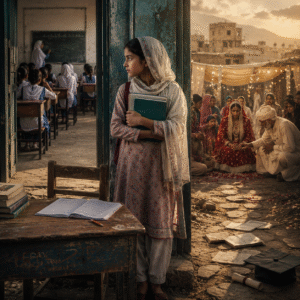
 The Empty Classroom Seats Child Marriage Continues to Leave Behind
Saliha (name changed), a girl from a remote village in District Kohat, once dreamed of becoming a teacher. She enjoyed attending school, spending time with her classmates, and imagining a future shaped by education. But before she could complete her studies, her family arranged her marriage. Within months, her schoolbooks were set aside, her daily routine changed, and her education came to an abrupt end. Like thousands of other girls across Pakistan, the classroom seat she once occupied now stands empty.
Her story reflects a reality faced by countless girls whose education is interrupted by child marriage. While child marriage is often discussed in terms of health risks and violations of children’s rights, its impact on girls’ education receives far less attention. For many girls, marriage marks not only the end of childhood but also the end of their educational journey.
Pakistan remains among the countries where child marriage continues to affect a significant number of girls. According to the Pakistan Demographic and Health Survey 2017-18, 3.6 percent of girls are married before the age of 15, while 18.3 percent are married before reaching the age of 18. The survey also found that 8 percent of adolescent girls aged 15 to 19 are already mothers or pregnant with their first child, while 15 percent give birth before turning 18. The situation in Khyber Pakhtunkhwa is particularly concerning. Child marriage prevalence stands at 28 percent in settled districts and rises to 35 percent in the merged tribal districts.
According to UNICEF, more than 21 percent of girls in Pakistan are married before the age of 18. The World Health Organization has similarly identified child marriage as a persistent challenge affecting girls across the country, particularly in rural areas. Behind these statistics are thousands of girls whose education, aspirations, and opportunities are cut short.
The relationship between child marriage and school dropout is direct. Once married, girls are often expected to take on household responsibilities, care for family members, and begin childbearing at a young age. Continuing education becomes difficult and, in many cases, impossible. Many girls are unable to sit examinations, pursue higher education, or develop the skills needed to participate fully in economic and public life.
For Saliha, leaving school was not a decision she made herself. She watched her classmates continue their studies while she adjusted to a new life filled with responsibilities that few children should be expected to shoulder. Although she still hopes to continue her education one day, returning to school after marriage remains challenging. Her experience demonstrates how child marriage removes girls from classrooms not because they lack ambition or ability, but because circumstances beyond their control leave them with few alternatives.
Maham Nafees, a leader of the Rise and Shine Girls Education Leadership Network, believes that girls consistently express a desire to continue their education but are frequently denied the opportunity to make decisions about their own futures.”Every time a girl leaves school because of child marriage, a classroom loses a student and society loses a future leader,” she said. “Girls consistently tell us they want to continue their education, but many are denied the opportunity to decide their own future. Education gives girls the confidence, knowledge, and opportunities needed to shape their own lives.”
Education is widely recognized as one of the strongest protective factors against child marriage. Girls who remain in school are more likely to delay marriage, participate in the workforce, and make informed decisions about their health and well-being. Schools provide not only learning opportunities but also safe spaces, mentorship, social networks, and pathways toward economic empowerment.
The consequences of child marriage extend far beyond individual girls. Early marriage contributes to lower educational attainment, poorer health outcomes, reduced workforce participation, and the continuation of intergenerational poverty. Communities lose future teachers, health workers, entrepreneurs, and leaders when girls are forced to abandon their education prematurely.
Recognizing these challenges, several provinces have strengthened legal protections against child marriage. Sindh, Punjab, Balochistan, and Islamabad Capital Territory have taken legislative steps to establish 18 years as the minimum age of marriage for girls. However, Khyber Pakhtunkhwa and Gilgit-Baltistan still lack comparable legal protections.
This disparity is particularly important because legislation sends a clear message about society’s commitment to protecting children. While laws alone cannot end child marriage, they provide an important framework for prevention, accountability, and awareness.
In Khyber Pakhtunkhwa, efforts to strengthen safeguards for children have been underway for several years. The proposed Child Marriage Restraint Bill has undergone extensive consultations and has reportedly received endorsement from the provincial Law Department. Despite receiving support from child rights advocates and legal experts, the legislation remains pending. The continued delay has raised concerns among education and child rights activists, who argue that every year of inaction leaves thousands of girls vulnerable to early marriage and school dropout.
Shazia Tehmas Khan, Member of the Provincial Assembly and Vice President of the Women Parliamentary Caucus, emphasized the importance of protecting girls’ right to education.”No girl should have to choose between education and marriage,” she said. “Strengthening legal protections against child marriage is essential if we want more girls to complete their education, participate in the economy, and contribute to society. Protecting girls’ education must remain a priority for policymakers.”
Child rights advocates argue that legislation is only one part of the solution. Experience from across Pakistan demonstrates that laws must be accompanied by effective implementation, public awareness, community engagement, and investments in girls’ education. Sindh, despite having one of the country’s strongest legal frameworks against child marriage, continues to report high prevalence rates. This demonstrates that legal reform, while essential, must be accompanied by broader social change.
Yumna Aftab, Program Officer at Blue Veins and Girls Rights Activist, believes that efforts to prevent child marriage and promote girls’ education must go hand in hand.”In many communities, child marriage and school dropout go hand in hand,” she said. “Once a girl leaves school, the risk of early marriage increases significantly, and once she is married, returning to education becomes extremely difficult. Keeping girls in school is one of the most effective ways to prevent child marriage and expand opportunities for young women.”
The economic costs are equally significant. Studies estimate that ending child and early-age marriage in Pakistan could save approximately $77 million by 2030 while increasing productivity and earnings by as much as $6.2 billion. Reducing child marriage would also contribute to lower poverty levels and to improvements in health, education, and gender equality.
For girls like Saliha, however, the issue is not measured in economic projections or policy debates. It is measured in unfinished homework, abandoned ambitions, and opportunities that may never return. Every girl who leaves school because of child marriage represents a loss not only for herself but also for her family, community, and country.
Keeping girls in school remains one of the most effective strategies for ending child marriage. Every additional year of education increases a girl’s chances of achieving economic independence, participating in public life, and making informed decisions about her future.
Somewhere in Kohat, Saliha still hopes to continue her education. Her story is shared by countless girls whose dreams are interrupted by early marriage. Whether future generations of girls remain in classrooms or leave school prematurely will depend on the choices families, communities, and policymakers make today. Until then, the empty classroom seats left behind by child marriage will continue to remind us of opportunities lost and futures left unrealized.
Writer Irshad Ullah

